
Hunan Province
Zhangjiajie
A practical Zhangjiajie guide for distinguishing park areas, transfer times and overnight bases before making an itinerary.
Suggested stay: 3 days
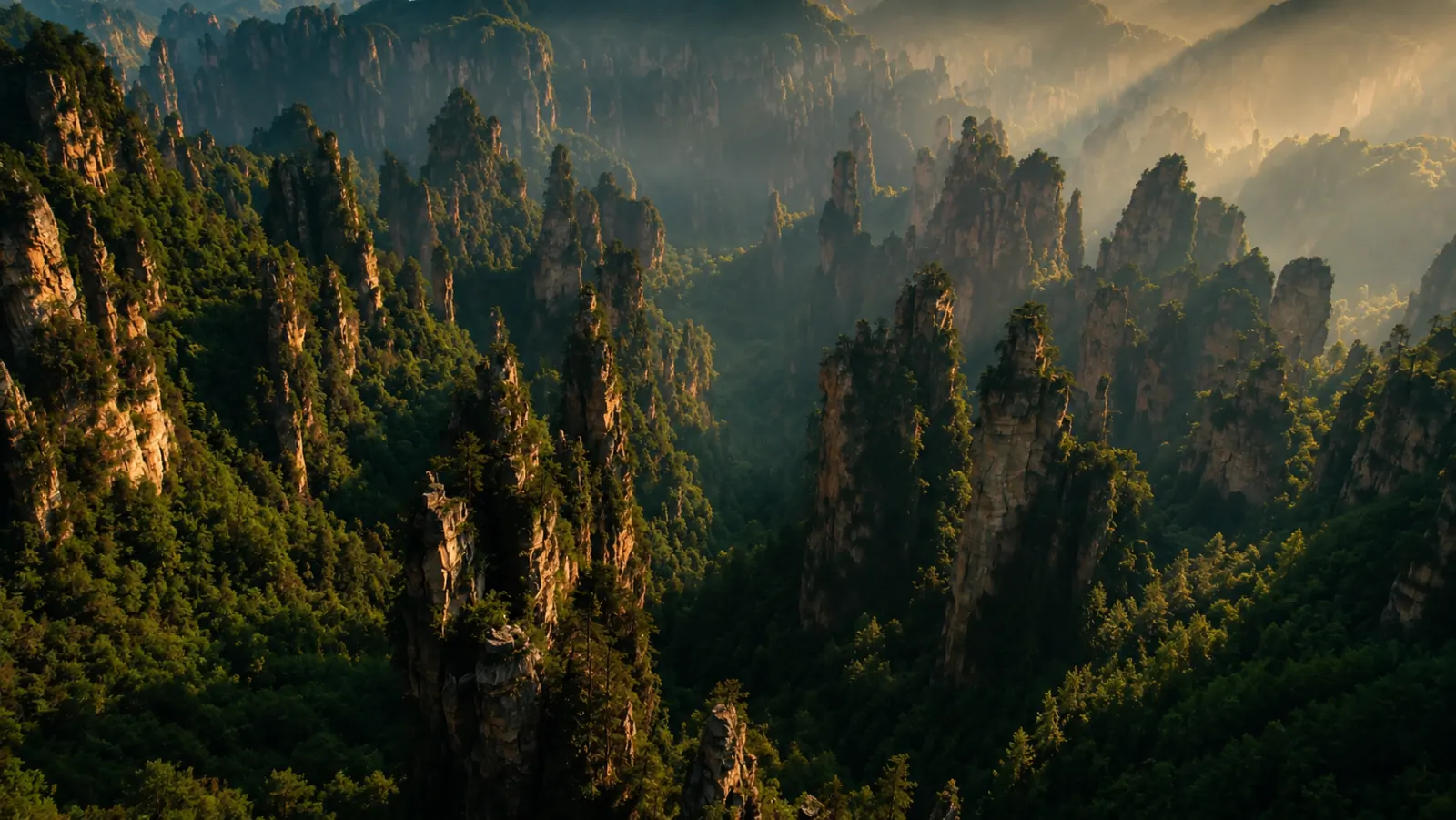
Zhangjiajie rewards a slow, weather-aware plan. Mountain scenery, lifts, buses, walking trails and park gates are not interchangeable, and a place shown close together on a map may take much longer to reach on the ground.
Zhangjiajie at a glance
| Category | Practical assessment |
|---|---|
| Recommended stay | 3 full days when combining Wulingyuan and Tianmen Mountain |
| Arrival geography | Airport, rail stations, Zhangjiajie city and Wulingyuan are distinct bases |
| Core transport | Preplanned transfer plus scenic-area transport; do not assume one ticket covers another area |
| Booking pressure | Check park, cableway, shuttle and gate rules directly with each operator |
| Walking demand | High: slopes, steps, platforms and weather exposure |
| Main planning risk | Confusing Wulingyuan and Tianmen Mountain or relying on an unverified final return |
Arrival, rail stations and choosing the right base
Zhangjiajie Hehua International Airport — 张家界荷花国际机场 —, Zhangjiajie West Railway Station — 张家界西站 —, the city, Wulingyuan — 武陵源 — and Tianmen Mountain — 天门山 — are distinct locations. Confirm flight and rail details with the carrier, China Railway’s official 12306 system, and the accommodation before deciding on a first-night transfer. Keep the full Chinese hotel address and the actual entrance offline.
Choose the base for the next morning’s gate, not a broad “Zhangjiajie” label. Wulingyuan suits a park-focused sequence; a city-side hotel can be more useful for a Tianmen plan or a transport connection. Confirm the specific pickup point, transfer method and realistic final return with the responsible provider. Do not treat an arrival day as a spare mountain day after a flight or long train.
Decide which landscape you mean
“Zhangjiajie” can refer to the city, its surrounding scenic districts and several very different excursions. Wulingyuan, Tianmen Mountain, town facilities and farther natural areas should be planned as separate choices, not as stops to squeeze into one day. Write down the Chinese names and exact entrances for the sights you select. This avoids a common planning mistake: arriving at the correct broad area but at a gate or transport hub unsuitable for the day’s route.
Give Wulingyuan a dedicated block of time
The UNESCO World Heritage List record for Wulingyuan describes the protected area’s quartzite sandstone pillars, ravines and forests. It supports the area’s heritage importance, but it is not a live park map, ticket page or operating notice. A visit can involve a combination of gates, internal road transport, slopes and viewpoints. Plan only a manageable section per day, retain a return buffer and check which entrance best fits your accommodation and intended route.
Use official material for context, then verify operations
The Hunan Department of Culture and Tourism’s English page on Zhangjiajie National Forest Park is useful background on the wider destination. Its publication date means it must not be treated as confirmation of today’s fares, required reservations, shuttle routes, opening hours or maintenance closures. Before departure, use a current official site notice or the venue’s verified service channel to establish the precise ticket product, time slot, accepted identification and last practical return transport.
Treat altitude and weather as route conditions
Mist, rain, wind, heat and sudden temperature changes can materially change a mountain day. Views may disappear even when trails or vehicles remain open; conversely, a weather warning may affect cableways, lifts or access. Pack layers, waterproof protection, drinking water and footwear with grip, but do not assume ordinary equipment makes an exposed route safe. Read official local warnings close to departure, ask accommodation staff about immediate conditions and keep a low-level cultural or rest-day alternative available.
Build the flexible alternative before you leave the hotel. It might be a meal near the gate, a rest afternoon, or an indoor activity in town, but it should not depend on another long mountain transfer. Keep the reservation terms available offline so a weather-driven change can be judged against the operator’s current conditions rather than an old social-media post.
Do not build the day around a single photo point
View platforms and well-known formations can be busy, and popular images rarely show waiting times, gradients or the distance back to an exit. Choose an area for its overall walking and landscape experience rather than treating one viewpoint as a timed appointment. If a queue becomes excessive or visibility is poor, change the plan early. Avoid leaving the final cable car, shuttle or long trail descent until the end of the operating day; current cut-off times need direct confirmation.
Separate Tianmen Mountain from the park itinerary
Tianmen Mountain has its own access pattern and should be researched independently from Wulingyuan. Do not assume a ticket, shuttle, cableway or time reservation at one scenic area applies to the other. Start with the responsible attraction’s current official information, determine the exact departure point, and allow realistic travel time from your hotel. If combining activities on an arrival or departure day, build in an especially generous margin: late flights, rain or queues can make a tightly sequenced plan impractical.
Choose accommodation by the next morning’s gate
A hotel described broadly as “in Zhangjiajie” may be convenient for one scenic area and inconvenient for another. Before booking, confirm the full address in Chinese, the actual driving time to the intended entrance, early breakfast availability and the likely first transport option. Keep the address offline and ask the property for pickup or arrival instructions if you will arrive after dark. For a multi-day stay, changing base can sometimes be easier than making repeated long transfers.
Use holiday reporting carefully
An English Hunan government report on May Day tourism illustrates that major holiday demand can be intense. It reports on a specific past period, not a forecast or booking instruction for your trip. During public holidays and school breaks, make fewer fixed commitments, expect crowd-control measures and check whether advance slots are required.
Keep transport decisions reversible
Mountain travel often involves an arrival transfer, a gate shuttle, internal scenic transport and a return to town. Save receipts and ticket details, photograph signs only where permitted, and leave enough battery to translate or show addresses. Do not board an unverified vehicle simply because it appears to serve tourists; compare the plate, driver and booked destination with your reservation. When the route is unclear, ask a staffed hotel desk or official visitor point for help rather than accepting a persuasive on-the-spot itinerary.
If you plan to move between city districts and scenic areas, ask for the departure point, frequency and final service in writing or on a screen you can retain. A transfer may be sold as part of a package but still require an early meeting point or an additional local shuttle. Keep an offline map, a power bank and enough time to return to a staffed location before the final connection. When a journey has multiple changes, an arranged private transfer from a reputable provider may be easier to evaluate than an improvised sequence of vehicles.
Respect protected landscapes and personal limits
Heritage scenery is not a controlled indoor attraction. Follow barriers, posted trail rules and staff directions; avoid shortcuts, drone use or climbing that is not expressly allowed. Take rests before you become fatigued, especially on wet steps or crowded platforms. If travelling with children, reduced mobility or a fear of heights, assess each route’s stairs, exposure, lifts and evacuation options directly with the operator. Accessibility information should never be inferred from photographs or broad destination descriptions.
Bring only what you can manage over steps and while boarding vehicles. A lightweight day bag, water, rain layer, phone power and a small first-aid supply may be more practical than heavy luggage. Tell a companion where you intend to finish the day and establish a simple fallback meeting place if mobile signal or translation becomes difficult. Travellers with a medical condition should consider how long an internal route may take and whether they can safely reverse it before beginning. Emergency and health-service information should be checked locally rather than copied from a generic travel page.
Before you go and maintained planning guides
- Confirm whether the accommodation, ticket, gate and transport refer to Wulingyuan or Tianmen Mountain.
- Save Chinese names, exact entrances, pickup points and a written final-return plan before leaving the hotel.
- Keep passport-linked confirmations, offline maps, translation, payment backup and a power bank ready.
- Pack layers, rain protection, water and footwear with grip; exchange a mountain day for a lower-effort alternative when responsible alerts or conditions call for it.
- Recheck each operator for current access, cableway, shuttle, reservation and weather arrangements rather than using a past itinerary.
Use the China Travel Pulse visa and transit checker as a planning aid, then verify the whole journey with responsible authorities and the carrier. The maintained guides to airport transfers, high-speed rail, attraction bookings, payments and map apps help with national trip mechanics.